Two weeks in the Bevy den
A brutal asset audit, then the best the room ever looked in Rust, and the conclusion that the engine was the ceiling.
Written after the fact, from the commit history and the design logs.
September opened with an audit that pulled no punches. Twenty-six game assets were rendered and compared, by a vision pass, against the cinematic reference frames. Six were even the right object. Zero matched the reference’s form. The report’s summary line: every asset needs work, none ships as-is. The characters were image-to-3D statues with smeared faces, no rig, no animation.
Then came two weeks of proving the room could still look right. Blockouts were replaced piece by piece with modelled assets. The desk was laid out to match the reference frame: keyboard grid, patch panel, cassette player, burner phone, soldering iron. A night-city plate went behind rain-streaked glass. Plank floor, wall grunge, cable spools. A render stack followed: bounced light from a captured environment map, temporal anti-aliasing, depth of field on the workstation, volumetric fog.
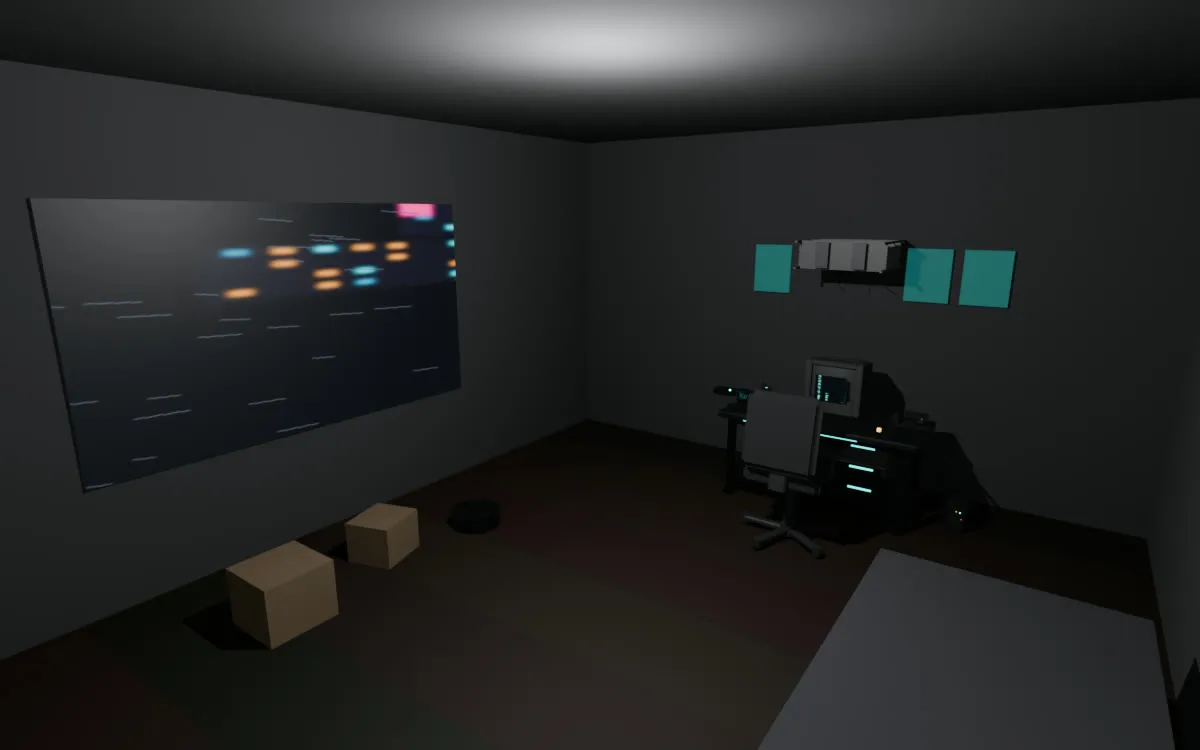
One debug note for the road. The Drifter model came out of the pipeline “shattered”, bright flecks all over the jacket. The flecks were the window showing through him: an over-aggressive decimation pass had left 44,955 boundary edges, a triangle soup. The fix was to ship the watertight 960,000-triangle mesh and eat the file size.
And then the honest sentence. This render was the ceiling. Bevy has no editor, no animation or character pipeline, and its raytraced GI is experimental. We were building an engine instead of the game. The film the room had to match was finished weeks later, and it forced the decision this post is really the setup for.